

Doctoral School of History
Uncategorised
Arhiva editia 2024 Musica Academica - scientific journal
Editorial Office: University of Oradea
Str. nr. 1, 410087 Oradea-Bihor
Phone: +40 259 408281
Email: This email address is being protected from spambots. You need JavaScript enabled to view it.
URL: https://doctorat.uoradea.ro/ro/evenimente2-7/399-musica-academica-scientific-journal
About Musica Academica:
ISSN (print): 3061-5364
ISSN-L: 3061-5364
ISSN (on line):3090-9902
Subject: Musicology
Language: Romanian/English
Publication Fees: None
Periodicity: Annually
Type of Publication: Scientific/Academic, Peer-Reviewed
Open Access: Yes (Fully Open Access)
Aims and Scope:
Musica Academica is a musicological research journal affiliated with the Doctoral School of Interdisciplinary Studies at the University of Oradea, Romania The journal’s main objective is to promote the dissemination of scientific and academic research in the field of music, including interdisciplinary approaches. Submissions are welcome from a wide range of thematic areas, including: music analysis, historical musicology, music theory, performance studies, music education, ethnomusicology and folklore, aesthetics, stylistics, composition, sociology/psychology of music, management/marketing studies, musical practice, music technology, and other lines of music research.
Submission:
Manuscripts should be submitted in Romanian or English (other languages may be considered) by email to: This email address is being protected from spambots. You need JavaScript enabled to view it.
The deadline for submitting articles is July 1st.
The format of the publication can be found in the “Instructions to Authors” section.
Authors assume full responsibility for the authenticity and scientific accuracy of the submitted papers.
Privacy Statement:
The names and email addresses provided to this journal will be used exclusively for the journal’s stated purposes and will not be made available for any other use.
Open Access Policy:
All articles published in Musica Academica are fully open access, freely available to read, download, and share. Musica Academica does not charge authors any publication fees or article processing charges.
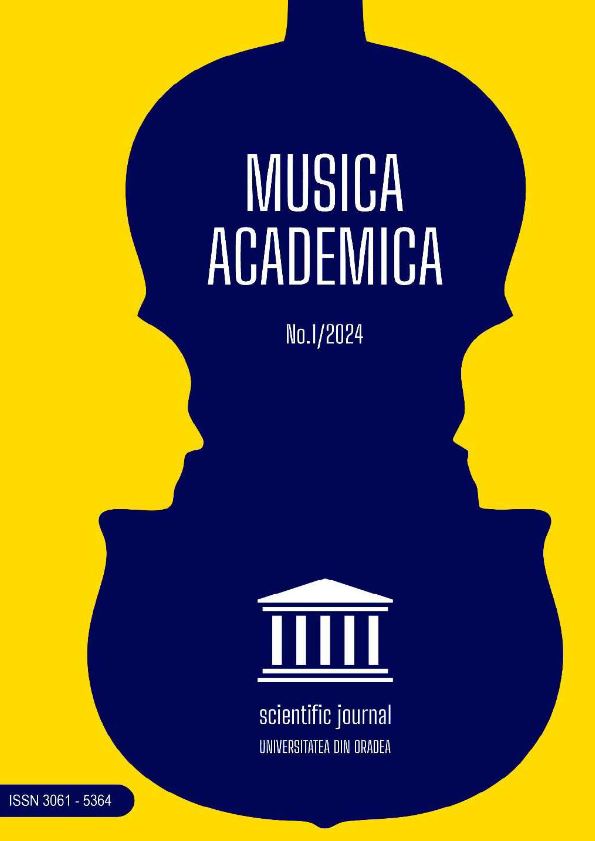 Revista Musica Academica - scientific journal ediția 2024 |
EDITORIAL BOARD/Colectiv editorial Scientific Board/ Colectiv științific Univ. Professor, PhD., Master of Arts, VICTORIA MELNIC, Academy of Music, Theater and Fine Arts, Faculty of Musical Art, Chișinău, Republic of Moldova Univ. Professor, PhD., SVETLANA BADRAJAN, Academy of Music, Theaterand Fine Arts, Faculty of Musical Art, Chișinău, Republic of Moldova Univ. Professor, PhD., habil., ELENA CHIRCEV,„Gh. Dima” National Academyof Music, Cluj-Napoca, Romania Univ. Professor, PhD., habil., GABRIELA COCA, Babes –Bolyai University,Music Department of the Faculty of Reformed Theology and Music, Cluj-Napoca, Romania Univ. Professor, PhD., CARMEN MIHĂESCU, Arts University of Târgu Mureș,Romania Univ. Professor, PhD., habil., LAURA VERONICA DEMENESCU, „Aurel Vlaicu” University of Arad, Romania Univ. Professor, PhD., habil PETRUȚA-MARIA COROIU, Transilvania University of Brașov, RomaniaUniv. Assoc. Prof., ION ARDEREANU, „Aurel Vlaicu” University of Arad, Romania Deputy/Managing Editor/ Director editorial Univ. Professor, PhD., habil., ROMEO RÎMBU, University of Oradea Editor in chief/ Redactor șef Univ. Professor, PhD., habil., MIRELA ȚÂRC, University of Oradea, E mail: This email address is being protected from spambots. You need JavaScript enabled to view it., nr.1 University str.,Oradea, Bihor Permanent editorial board/ Redactori Univ. Assoc. prof LUMINIȚA-VIRGINIA BURCĂ University of Music Bucharest Univ. Professor PhD habil. LAURA VERONICA DEMENESCU „Aurel Vlaicu” University of Arad Univ. Assoc. prof. PhD. MĂDĂLINA HOTORAN, Emanuel University of Oradea |
Peer Review Process:
Musica Academica employs a double-blind peer review system. Two music scholars from different universities will review the content of each submission without knowing the author's name or affiliation. The evaluation criteria are detailed in the "Reviewer's Guide." After review, the editor will send the reviewers' comments to the author. Accepted papers may be returned to the author for revisions. The author will be notified of the reviewers' and editors' decision regarding acceptance or rejection. Authors and reviewers remain anonymous to each other throughout the process.
Reviewer's Guide: Reviewers_Guide
Indexing: The journal is in the process of indexing
Instructions to authors:Musica_Academica_Author_Guidelines.pdf
Musica Academica - scientific journal indexing
În lucru
 |
||||
 |
 |
 |
 |
 |
Blended Intensive Programme (BIP)
INTRODUCTION TO MATHEMATICAL AND COMPUTATIONAL MODELLING
FOR SUSTAINABILITY - SECOND EDITION
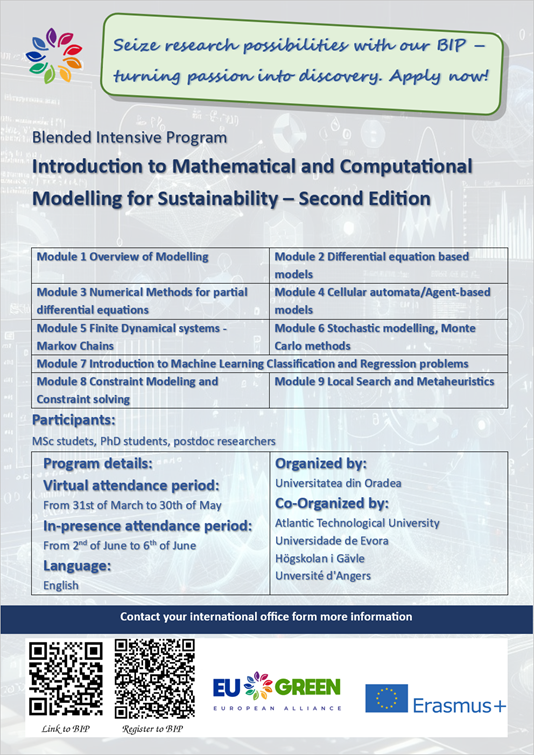
UNIVERSITY OF ORADEA, within the EU GREEN University Alliance, organizes Blended Intensive Programme open for all the students from EU GREEN partner universities.
Coordinating and organizing University
UNIVERSITY OF ORADEA (Romania)
Prof. Radu ȚARCĂ
Co-organizing Universities
Atlantic Technological University (Ireland)
Universidade de Evora (Portugal)
Högskolan i Gävle (Sweden)
Unversité d'Angers (France)
Programme details
- IN-PRESENCE attendance period: 2nd – 6th of June 2025;
- VIRTUAL attendance period: 31st of March – 30th of May 2025;
- Language of instruction: English;
- ECTS for participation in the programme: 6.
Programme description
This 6ECTS BIP will give an introduction to mathematical and computational modelling techniques for application in developing understanding and supporting sustainable decision making in health, environmental, societal, and industrial systems. The programme is designed for students at the Masters or Doctoral level who wish to develop these skills for application in research projects aligned to the EU GREEN research themes. This program prioritises high-level strategic thinking in the design and analysis of modelling paradigms and how they can be applied for effective decision making. Interpersonal skills together with technical skills are central to the learning outcomes.
Aims:
- Develop familiarity with fundamental approaches to mathematical and computational modelling methods, techniques and tools, including Differential Equations, Machine Learning/AI, Finite difference/element/volume method, Cellular Automata and Optimisation Algorithms,
- Develop awareness of which methods may be suitable for different types of research problems along with the potential benefits, challenges and limitations of each approach
- Develop skills in application of these methods to real-world multidisciplinary research problems aligned to the EU Green themes
- Develop student transferable skills in group working and communication;
- Help to create a culture of international and cross-discipline collaboration in postgraduate research at the EU Green institutions
The programme will consist of 9 x 2hr online weekly sessions and a week-long in-person summer school at the University of Oradea. The teaching will be delivered by different academic staff from ATU, HiG, Oradea, Evora and Angers. The summer school will comprise hands-on workshops, student presentations, and participation in a group project as well as social/networking opportunities. Students will select an individual project related to their own research domain with support from the academic staff.
As learning outcomes, it is intended to promote:
- Approach the formulation of health/societal/industrial/environmental problems into a mathematical/computational framework;
- Develop familiarity with a range of modelling and analytic approaches (mathematical & stochastic modelling, machine learning and optimisation);
- Build and analyse models of processes and physical systems. These models may be predictive or descriptive and may increase understanding of the processes/physical systems;
- Identify the limitations and weaknesses of a range of modelling/analytical approaches – in terms of accuracy, robustness, sensitivity, reliability, range of validity and resolution;
- Appraise a range of modelling/analytical approaches to solving a problem – in terms of the potential accuracy/resolution etc. of the model predictions but also taking account of the required investment in time and cost in order to develop and test the models;
- Program mathematical models/analytical tools;
- Communicate model findings and limitations to technical and nontechnical audiences (e.g. policy makers) including effective visualisation.
Assessment:
- Individual poster presentation (20%) – To introduce the student’s own Masters/PhD research at the beginning of the summer school;
- Group Project (20%) – To be completed and presented at the summer school;
- Individual Project (60%) – Written report. The project should typically comprise either (i) a high-level review of modelling relevant to the student’s research topic or (ii) some preliminary modelling work relevant to the student’s research topic.
Total number of participants by institution
The BlP is open to a maximum of 25 participants from the EU GREEN universities.
Admission profile
Students can be MSc, PhD or postdoctoral researcher, but should normally have completed at least 5 ECTS relevant to Mathematics/Statistics at undergraduate or master level.
Conditions for Admission
- participation to the program is open to MSc, PhD or postdoctoral researcher;
- to apply for this program, students must be regularly enrolled at one of the participating universities and completed a course in Programming, Mathematics/Statistics, or similar content;
- at the time of the application submission, applicants must demonstrate proof of English language competence at the B2 level. This can be certified by the applicant’s home University.
How to apply
- Students should complete the APPLICATION FORM
- Students should send the following documents to This email address is being protected from spambots. You need JavaScript enabled to view it. till 16th March 2025:
- copy of ID or passport;
- transcript of records and certificate of enrolment;
- proof of English language competence.
Deadline for application – March 16th, 2025
Selection procedure
An appointed Committee of the organizer and co-organizer institution will carry out the selection procedure.
Students and researchers should expect to hear back about the result of their application by 25th of March 2025. Selected students must communicate their acceptance or withdrawal within 5 days from the publication of the selection results by contacting their university program coordinator. Selected students will be contacted with further instructions upon completion of the selection procedures.
Financial support
The attendance of the Blended Intensive Programme may be covered by an ERASMUS+ SMS Short Mobility Grant for all mobile students (excluding students from the hosting University). This financial support may only be guaranteed by the selected student’s home University. The University of origin of each selected student is fully responsible for the management of the financial aspects of the mobilities in accordance with the provisions of the competent ERASMUS+ National Agency.
No financial support is foreseen for host institution students as they will not be traveling for the purposes of participation in this program (non-mobile participants).
Please refer to your local coordinator or Erasmus/International Relations Office for any further information related to the financial support made available.
Administration contact:
Dr. Dan Noje
Research Development Innovation Programs and Projects Office
University of Oradea
This email address is being protected from spambots. You need JavaScript enabled to view it.

.